A Small Sketchbook Walk Through One Street
A small sketchbook walk through one street helps you record sign shapes and placement without judging their design, using a pace that suits your route.
You pause outside a corner shop while someone searches for keys, and notice that its sign is a narrow strip above the door. A small sketchbook walk through one street turns moments like this into a record of three different sign shapes and where each sits. The aim is to observe, not score the signs or decide how they ought to look.
Choose your approach by the kind of walk you have. A familiar route suits slow comparison; a short errand calls for quick notes; a busy street may be easier to observe from a quiet stretch or across the road. In each case, record what you can see without blocking a pavement, staring into private premises or treating your sketches as a design critique.
Choose your walking pace
For a familiar route
Take a street you already know and walk it at an unhurried pace. Familiarity helps you notice details that usually fade into the background: a blade sign fixed at right angles to a wall, a painted name on a window, or a board set low near a doorway. Stop only where you can stand comfortably and safely.
Use this route if you want to compare how signs occupy different parts of the same streetscape. A shop sign above an entrance, a projecting sign near the kerb and lettering on glass each meet the viewer from a different position. Your notes can describe those relationships without ranking them.
For a short errand
If you are already going to the post box or a local shop, make the walk your occasion. Choose one side of the route, and note the first clear example of each shape you encounter. A quick sketch can be a rectangle with a line for text and a dot or arrow showing the entrance; it need not reproduce the lettering.
This approach fits a tight window because it asks for three observations, not a complete survey. If the route does not offer three distinct shapes, record the difference you did see and leave the rest blank. The absence of a suitable example is part of the walk, not a reason to invent one.
For a crowded street
When people, traffic or market stalls make stopping awkward, keep moving and make a short note once you reach a clear place. You might remember “round sign, high, beside doorway” well enough to draw it there. Do not step into a cycle lane or stand in a shop entrance to get a better view.
A quieter side street can work better than the busiest stretch. Choose it if you want time to observe placement without competing with movement around you. The exercise is about seeing signs in context, not collecting the most conspicuous examples.
Set up a light page
Bring a pocket sketchbook or a few sheets of paper, a pencil and, if useful, a soft eraser. Leave room for three small drawings and a few words beside each. A page divided into three loose areas is enough; avoid turning the walk into a form to complete.
Before setting off, write the street name or a simple route description and the date if you want to revisit the page later. You do not need to record business names. A shape, location and brief note can identify what caught your attention while keeping the focus on visual structure.
Think of each sketch as a shopping-list doodle, not a miniature poster. A few marks should carry the useful information: outline, approximate height, nearby doorway or window, and direction faced. If detail begins to take over, stop drawing and add a word instead.
Record three sign shapes
Look for three visibly different forms rather than three different businesses. These categories are prompts, not rules; a sign may combine them.
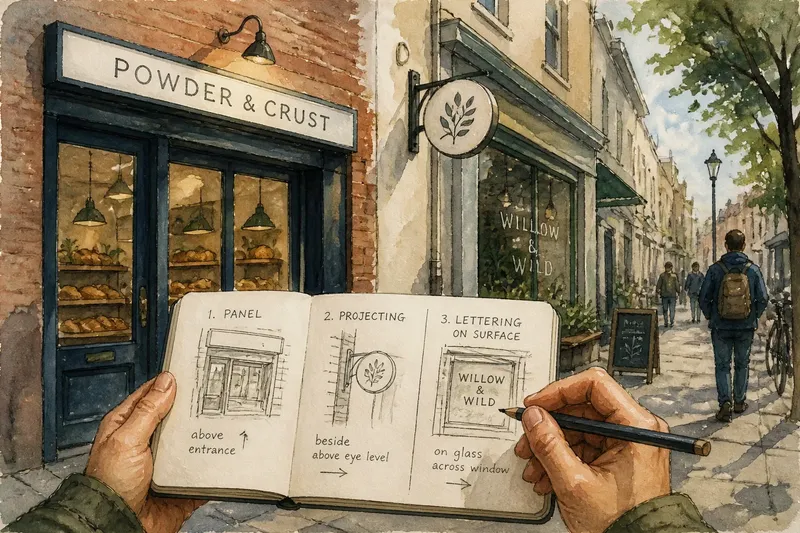
- Panel: A flat, often rectangular board or strip. Sketch its outline and note whether it sits above a door, across a window or on a wall.
- Projecting sign: A sign that extends out from a building. Mark the wall as a short line and draw the sign reaching away from it, then note whether it is above eye level or near a corner.
- Lettering on a surface: Words painted, applied or displayed directly on glass or a wall, without a separate board around them. Indicate the surface and where the lettering begins in relation to the entrance.
Other shapes may turn up: a round plaque, a hanging oval or lettering arranged around a doorway. Use the form you actually see. The point is to tell the three records apart, not to force every sign into a fixed category.
Map placement without judging
For each sign, note its position using simple relationships: above, beside, across, behind or projecting from. Add one landmark such as a door, window frame, corner or awning. These words make placement legible even when the drawing is rough.
Keep observation separate from evaluation. “Narrow board above entrance” describes what is there. “Too small” judges it against an unstated standard. You can have design opinions, but leave them off this page so that the drawing remains a record of what you noticed.
Say you are walking past a bakery and see a long panel over its door, a small round sign on the side wall and pale lettering on the front window. You sketch each outline, mark the entrance in the same simple way, and write “above”, “beside” and “on glass”. The result is a compact comparison of shape and placement, not a verdict on which sign works best.
When should you change the route?
What if I cannot find three shapes?
Record the signs available and note which shape did not appear. You can take another route on a different walk, but do not count three versions of the same panel as three different shapes just to fill the page.
Should I copy the words?
Only if the wording helps you remember the sign’s location or form. A line, block or blank space can stand for text, keeping attention on shape and placement rather than on a business’s message.
Can I draw from across the street?
Yes, if you have a clear view and can stand in a safe, permitted place. A distant sketch can still show whether a sign is flat, projecting or attached to glass, along with its position against the building.
What if a sign is partly hidden?
Draw the visible outline and mark the obstruction with a short note such as “behind awning”. Do not fill in what you cannot see; the gap records the limits of that particular view.
Close the page on the walk
When you finish, glance over the three sketches and check that each has a shape and a placement note. Add a small arrow if the sign faces towards the street, along it or towards an entrance. This is a quick way to make orientation clear without redrawing the scene.
Keep the page as an observation, not a set of instructions for improving the street. A small sketchbook walk through one street is most useful when it preserves differences you might otherwise overlook: a sign’s outline, its relation to a doorway and the angle from which a passer-by meets it. If you repeat the exercise, change the route or walking pace and let the next page show what that particular walk offered.